
Everything in this business runs on a constructed image. A stage name, an amplua, a look that stays recognisable across a decade of releases – that’s the product, and it’s why rankings and profile pages work at all. Audiences track a persona. The person behind it keeps her life, her own name, and usually a very different wardrobe.
Transformation games take that same idea and hand you the controls. You don’t watch someone else’s persona being maintained; you sit inside one that changes while you’re wearing it. The genre has been quietly enormous for twenty years, mostly out of sight of anyone who doesn’t already play it, and it deserves a proper explanation rather than the usual tag-dump.
Start with the thing that surprises newcomers: the appeal isn’t the ending.
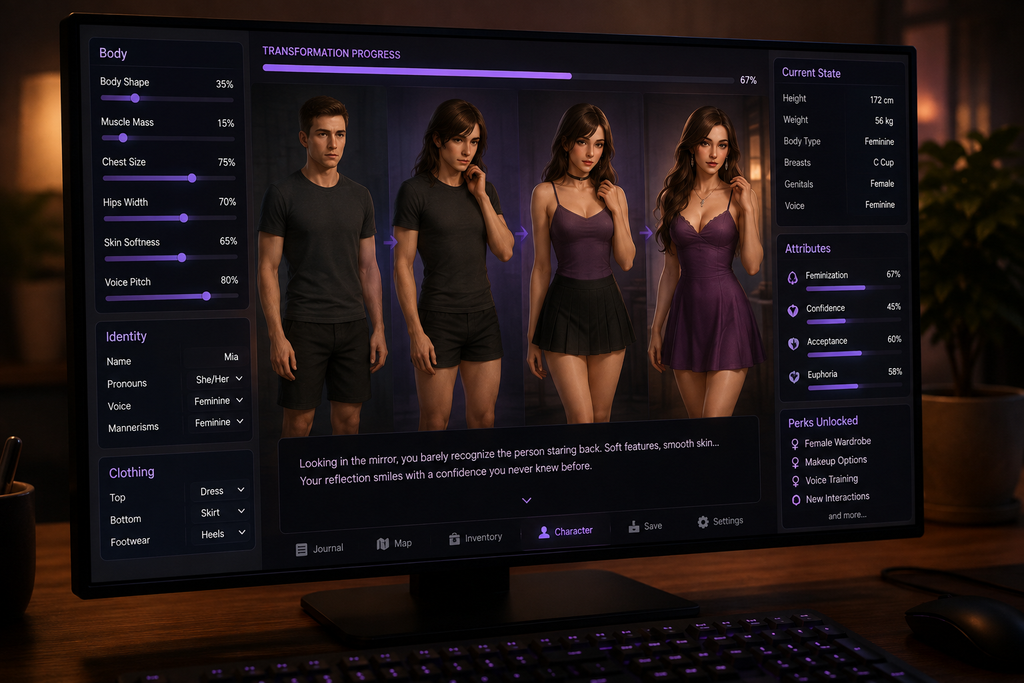
The interesting part is the middle
Nobody plays these for the after-picture. If the after picture were the point, one image would do the job and you’d be gone in forty seconds.
People stay for the half-finished state – the paragraph in hour two where the narration describes your character’s hands differently than it did in hour one, and you stop and reread it because you didn’t notice the change happening. The body that no longer matches the clothes. The dialogue option that appears because you’re not who you were on Tuesday.
Which is why so much of the category disappoints. A tag saying “transformation” costs a developer nothing. A game where transformation is a working system costs years, and players who’ve been in the genre a while can name the good ones on request.
Under the hood, it’s a state machine
Strip the art away and one of these games is a pile of variables with thresholds attached.
Height, build, chest, hips, skin, hair, genitals, voice, mental state, sometimes species – each a number or an enum, each with breakpoints. Cross a threshold and the game swaps in different descriptive text, opens or closes dialogue, changes what NPCs call you, changes which clothes fit, occasionally changes what the game will let you do at all.
The well-built ones assemble every scene from your current state before rendering it. You walk back into a room you saw in the first ten minutes and the same encounter reads differently, because the prose is stitched together from your variables rather than pulled from a fixed script. That’s the effect people chase – it feels like the world noticed.
The lazy ones hardcode three checkpoints, start, middle, end, and everything between is flavour text that never updates. You feel this within twenty minutes, as the narration continues to describe a body you no longer have.
A fixed image sells; a moving one has to be written
Here’s the tension that shapes the whole genre, and it’s the same tension the industry itself lives with from the other direction.
A persona earns its value by staying recognizable. That’s the entire logic of a brand: same look, same name, same associations year after year so an audience can find you again. Consistency is the asset.
A transformation game needs the opposite. Its asset is instability – the body has to be able to become something else, repeatedly, on demand, in combinations the developer never explicitly planned. And that runs straight into arithmetic.
Say a game tracks six body regions with five states each. That’s 15,625 possible configurations. Add clothing, add two scenes per state, and you’re asking an artist to produce a number of images no adult indie project on earth is funding.
Text doesn’t have that problem. A sentence assembled from variables costs the writer one conditional and covers every combination for free. So the genre settled where the maths worked: Twine and SugarCube for HTML games, RPG Maker for the ones with maps and grinding, Ren’Py for the more novel-shaped titles, plus a long tail of custom engines built by one obsessive person over several years.
It also explains something that confuses newcomers: a beautifully rendered transformation game is usually a shallow one. When the art budget rises, the number of trackable states falls, and the developer compensates with two or three fixed forms and a slider. Pretty, but you’ve traded a state machine for a wardrobe. Both are legitimate – know which one you’re settling in with before you give it an evening.
The one test that sorts this genre
Every category has a tell. For this one it’s this:
Open the character or body screen. If there isn’t one, the transformation is decorative. A game that models your body will show you the model: a status page, a body screen, a list of parts with current values. Its absence means the change exists only in cutscenes.
Then the follow-up: change one thing and reread something you’ve already read. Take an item, cross a threshold, go back to an early scene or an NPC you’ve already spoken to. Identical text means the system isn’t wired into the writing, and you’ve found a slideshow wearing the genre as a costume.
Two more. Check whether it’s reversible – one-way designs are a valid choice, but you want to know before you’re forty minutes into a path you can’t leave. And look for a version number and a dev log. These are famously long-running projects, often sitting at 0.6 or 0.7 after years of work, with dated changelogs. No version, no author, no update history usually means someone repackaged a build and wrapped it in advertising.
Sorting through a curated section beats clicking whatever search throws at you, which is the practical argument for browsing transformation porn games in one place rather than gambling on random links.
The sub-genres and what each asks of you
The umbrella covers things that barely share an audience.
Gender swap and TG is the oldest branches and still the largest. Slow, social, and mostly about how other characters react rather than anatomy. These live or die on their writing.
Species and anthro TFs trade social consequence for spectacle and tends to have the deepest part-tracking, because non-human bodies hand the developer more variables to play with.
Corruption and mental change moves the system from the body to the mind – willpower, inhibition, obedience, whatever the developer calls it. This branch is the likeliest to include material some players want nothing to do with, which brings us to toggles in a moment.
Expansion and size is mechanically simple and mostly a pacing exercise. It works best when growth costs something.
Possession and body swap is the outlier: no gradual change, just an abrupt relocation, then a game about maintaining a lie – which, given the subject of this site, is the branch closest to a story about wearing a persona in public.
Breeding and pregnancy is where systems get genuinely interesting. In a shallow game, a scene where you impregnate a character happens and then it’s over. In a built one, it starts a clock: gestation counted in days, a body that changes on its own schedule, stats that shift, sometimes a paternity table the game remembers, sometimes offspring that persist as characters. That’s the line between a kink tag and a mechanic, and you can see which one you’ve got inside an hour by checking whether anything is tracked afterwards.
Content toggles mark a serious build
The genre drifts into territory that not everyone in its audience wants, and developers who know their community handle that with settings rather than surprise.
A well-made transformation game lets you switch content lines off – breeding, corruption paths, specific fetishes, whole subsystems – from a preferences menu, usually before the first scene. That isn’t squeamishness. It’s an acknowledgement that a game with fifty branching kinks will hand every player a few they never asked for, and adults would rather set their own limits than have the RNG set them.
The menu also tells you something about build quality. Toggles are only possible when content is properly modular, which means the person who wrote it understood their own systems. Games with no filtering usually have the same hardcoded transformation at three checkpoints.
Practical bits, since these run long
These are progression games. You’ll be dozens of hours in before the more engaging state combinations open up, which makes save handling a real concern rather than a footnote.
Browser saves live inside the browser, not on a server, and they’re more fragile than people assume – especially on phones. If a game offers an export-save, a save code, or a download button, use it in your first session rather than your fifth. Everyone learns this the same way and none of the stories are pleasant.
Also: a browser game runs in the browser. If a page advertising web play starts steering you toward an installer, it lied in its first sentence and you can stop there.
The short version
The industry sells a persona that is deliberately kept steady. This genre sells the opposite – a body that keeps moving, tracked in numbers, described fresh every time you read a scene.
So test for it. Open the body screen, change one variable, reread something old, and see whether the game notices. If it does, you’ve found one worth the weekend. If it doesn’t, you’ve found a picture with a label on it, and the next tab costs you nothing.